

How Does Query Fan-Out Change SEO Content Architecture?
Oct 30, 2026
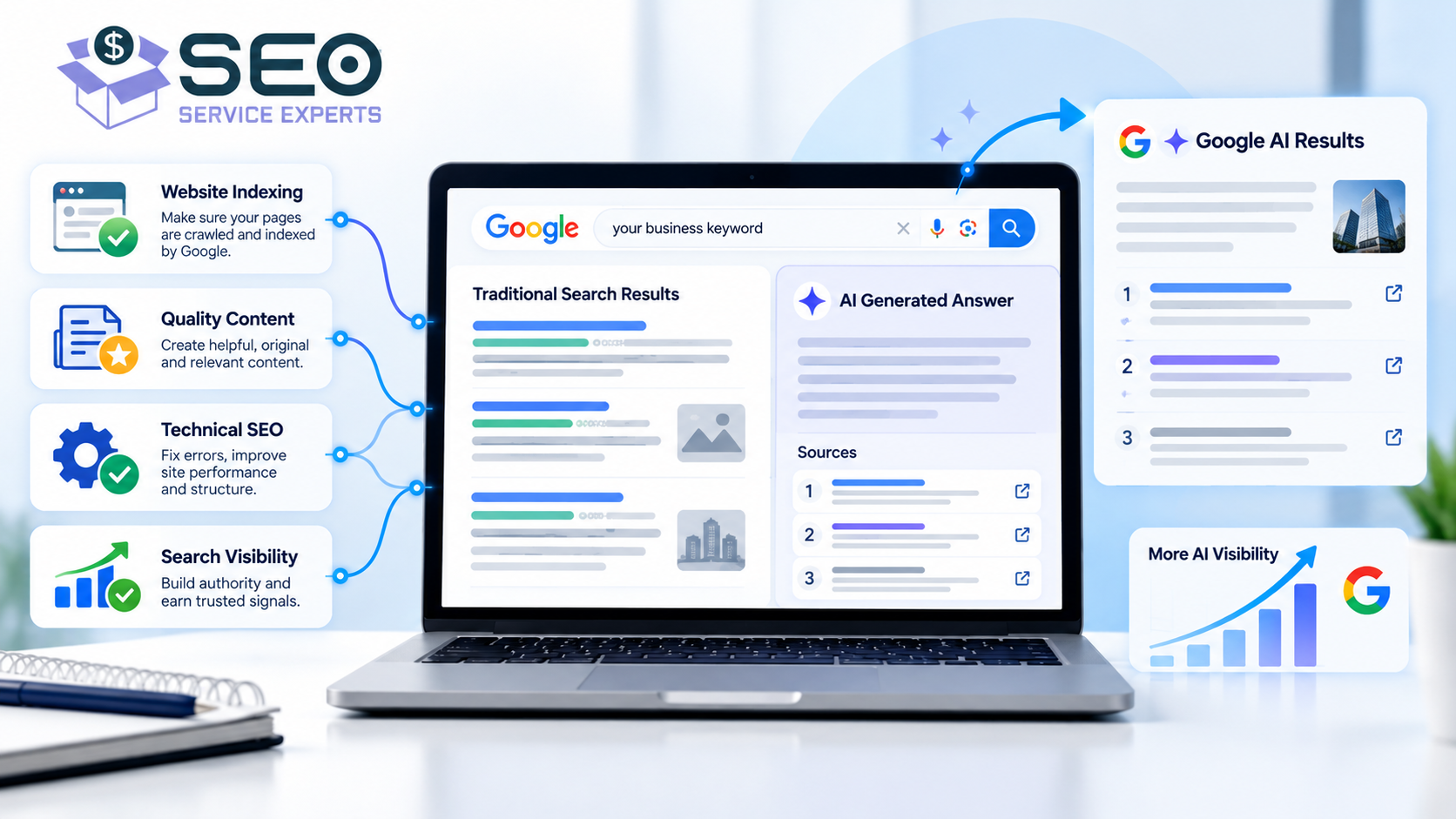
Have you noticed that your website appears in Google’s traditional search results but rarely gets mentioned or linked in Google’s AI-generated results? This can be frustrating, especially when you have already invested time and money in SEO.
The good news is that not appearing in an AI result does not necessarily mean your website has a penalty or that your SEO strategy has failed. Google’s AI search experiences evaluate information differently depending on the query, context, relevance, quality, and available sources.
If you want stronger visibility, you need to focus on the fundamentals that make your website useful, trustworthy, accessible, and easy to understand.
This guide explains the major reasons your website may not be appearing in Google’s AI results and what you can do to improve your chances.
Google’s AI search experiences are designed to provide users with more comprehensive answers to complex questions. Instead of requiring users to visit several search results individually, these experiences can summarize information and provide links to relevant sources.
This creates a new opportunity for businesses.
Your website does not simply need to rank for individual keywords. It needs to provide information that can help answer real questions clearly and comprehensively.
That means your SEO strategy should combine strong technical foundations with useful content, topical relevance, authority, and a positive website experience.
One of the most common reasons your website may not appear in AI results is that your content looks too similar to information already available online.
If your article simply repeats basic information, it may not provide a strong reason for search systems to select your page as a source.
Instead, add information that demonstrates genuine expertise.
You can include:
The objective is not to make your article longer for the sake of length. The objective is to make it more useful.
If another website has already explained a subject, ask yourself: What can you add that makes your explanation more valuable?
Search intent plays an important role in modern SEO.
Imagine someone searches:
“Why is my website not showing in Google’s AI results?”
They probably want more than a definition. They want to know why their website is missing, whether something is wrong, and what they should do next.
If your article only explains what AI search is, you are not completely satisfying that intent.
Create content that answers the complete question.
For example, discuss:
This gives users a more complete solution.
Publishing one article about a subject does not automatically make your website an authority on it.
If you want your website to become more visible for SEO-related searches, develop a connected collection of high-quality resources.
For example, an SEO website can cover:
Connect these articles naturally with internal links.
This helps create a clear topical structure and gives users additional resources to explore.
If you need help developing a stronger topical strategy, working with SEO Services Experts for comprehensive search optimization can help you identify content gaps and build a more organized SEO plan.
Before worrying about AI visibility, make sure Google can actually discover and index your important pages.
Check your website for:
Use Google Search Console to check whether important URLs are indexed.
If an important page is not indexed, it cannot contribute to your search visibility in the way you expect.
Technical problems can make it difficult for search engines to crawl and understand your website.
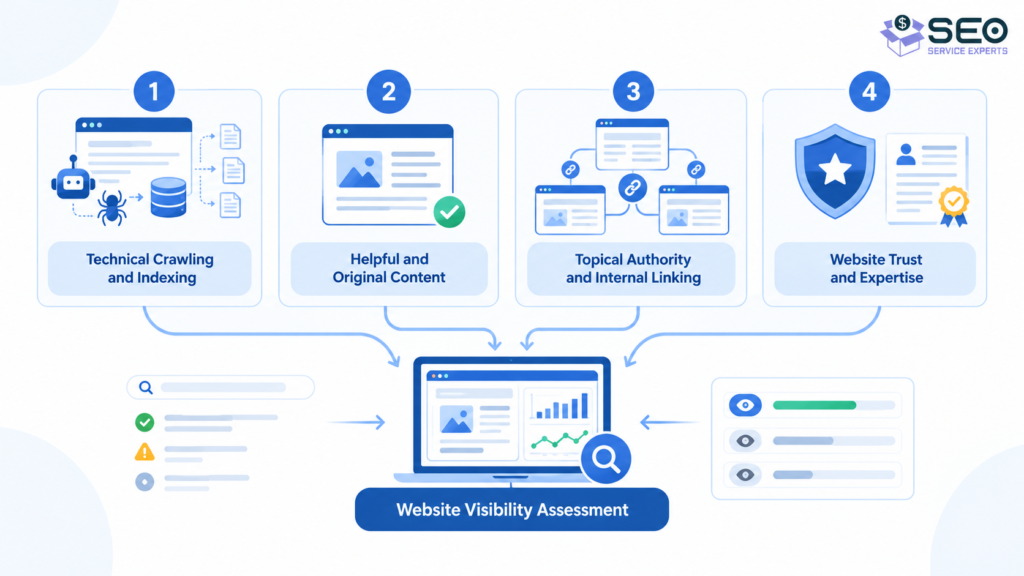
Review:
Technical SEO should be treated as the foundation of your search strategy.
If your website has technical weaknesses, consider getting an audit from SEO experts specializing in technical website optimization.
Generic content is one of the biggest challenges in competitive search results.
For example, an article titled “What Is SEO?” may provide basic information, but thousands of websites already explain the same subject.
You can make your content stronger by narrowing the topic and providing practical value.
Instead of writing:
“What Is SEO?”
you could create:
“How Can a Small Business Build an SEO Strategy From Scratch?”
The second topic addresses a specific problem and gives you more opportunities to provide actionable information.
Visitors should be able to understand why they should trust your information.
Strengthen your website by clearly presenting:
For professional service businesses, credibility can make a major difference in how users perceive your content.
Even excellent information can become difficult to use when it is poorly organized.
Make your content easier to understand with:
If your article answers a question, provide the answer early and then explain it in greater detail.
This improves usability and makes your information easier to navigate.
Traditional keyword targeting often focuses heavily on short phrases.
However, users increasingly search using detailed questions and conversational queries.
Instead of targeting only:
“SEO services”
consider content around questions such as:
This approach allows you to address a wider range of information needs.
Internal links help users move between related pages on your website.
Suppose you have an article about Google’s AI results. You can naturally link to relevant pages about:
Use descriptive anchor text that tells readers what they will find after clicking.
Avoid using vague anchors such as “read more” when a descriptive phrase would provide greater context.
SEO information can become outdated quickly.
Algorithms, search interfaces, best practices, and user behavior can change.
Review important content periodically and update:
Do not change content simply to make it look fresh. Update it when there is a genuine reason to improve its accuracy or usefulness.
Content quality alone is not enough if your website is frustrating to use.
Check whether your website:
A good page experience helps visitors consume your content and take the next step.
When you make important claims, support them appropriately.
Depending on your industry, useful supporting elements may include:
Evidence makes an article more useful and gives readers greater confidence in your recommendations.
A strong online presence is not built entirely through individual blog posts.
Build recognition by consistently publishing useful resources, maintaining accurate business information, earning legitimate mentions, and creating content that people want to reference.
Your brand should become associated with a clear area of expertise.
This is particularly important in competitive industries where many websites publish similar information.
A strong article does not stop at the primary question.
If your topic is “Why is my website not showing in Google’s AI results?”, related questions might include:
Answering relevant follow-up questions makes the resource more comprehensive.
Publishing blog posts randomly can create a large website without creating meaningful topical authority.
Before creating content, identify:
Then create content around these areas consistently.
A strategic approach is more effective than publishing articles simply because a keyword has search volume.
Getting visibility is only part of the objective.
Once visitors reach your website, you need to give them a logical next step.
Include relevant CTAs throughout your website, but keep them natural.
For example, an informational article about technical SEO can direct readers toward a technical SEO service. A content strategy article can lead toward a content optimization service.
Your CTA should match the visitor’s needs rather than interrupting the article.
Do not assume that your entire SEO strategy is unsuccessful simply because you cannot see your website in one AI result.
Search results can vary by query and context.
Instead, monitor broader performance indicators such as:
Look for trends rather than relying on one search.
You can follow a practical process to strengthen your website.
Find pages that receive impressions but have weak engagement or limited visibility.
Identify content that is outdated, thin, generic, or poorly structured.
Review the questions your audience actually wants answered.
Make sure each page provides a complete and useful solution.
Include experience, examples, research, data, case studies, and practical recommendations whenever relevant.
Create supporting content around your core services and connect related pages through natural internal links.
Review crawling, indexing, mobile usability, site speed, redirects, canonical tags, and other technical elements.
Make your business information, expertise, authorship, experience, and contact details easy to find.
Make pages fast, readable, mobile-friendly, and easy to navigate.
Target complete questions and problems instead of relying entirely on short keyword phrases.
Guide visitors toward useful next steps such as an SEO audit, consultation, service page, or contact form.
Yes, a well-planned SEO strategy can help strengthen the foundations that support visibility across modern search experiences.
Professional SEO work can help you identify:
The objective should not be to chase a guaranteed AI result.
Instead, focus on building a website that consistently provides valuable information and satisfies users.
If you want to improve your overall search presence, professional SEO services for sustainable website growth can help you develop a strategy around your website’s existing strengths and weaknesses.
Google’s AI search environment is changing how users discover information, but the fundamentals of quality SEO remain important.
A website with:
has a stronger foundation for long-term search visibility.
You should therefore treat AI visibility as part of your broader search strategy rather than as a completely separate SEO discipline.
If your website is not showing in Google’s AI results, don’t immediately assume that something is wrong with your domain.
Start by investigating the fundamentals.
Is your content genuinely useful? Does it satisfy search intent? Can Google crawl and index your pages? Have you developed authority around your core topics? Do your pages demonstrate expertise? Are your internal links helping users discover related information? Is your website easy to use?
Answering these questions can reveal opportunities that improve both traditional organic visibility and your ability to become a useful source within evolving AI search experiences.
Most importantly, don’t create content simply because you want to appear in an AI result. Create content because your audience needs a clear, trustworthy, and practical answer.
If your website is receiving traffic but struggling to gain stronger organic visibility, it may be time to look beyond individual keywords and review your complete SEO foundation.
From technical improvements and content optimization to topical authority and internal linking, the right strategy can turn existing weaknesses into measurable opportunities.
Want to find out why your website isn’t reaching its full search potential? Contact us for a personalized SEO strategy and take the next step toward stronger, sustainable website visibility.
Your website may lack sufficient topical relevance, original content, authority, technical accessibility, or strong alignment with the user’s search intent. Traditional rankings do not automatically guarantee inclusion in AI-generated results.
No. Ranking well in traditional search and being selected as a source for an AI-generated response are related but different outcomes. AI visibility can vary based on the query and context.
Yes. If important pages cannot be crawled, rendered, or indexed properly, search systems may have difficulty discovering and understanding your content.
You do not need to create content solely for AI search. Focus on producing original, useful, well-structured content that satisfies your audience’s questions and follows strong SEO fundamentals.
Improve content quality, search-intent alignment, topical authority, technical SEO, internal linking, credibility signals, website experience, and original value. Then monitor your broader organic search performance.