

How Does Query Fan-Out Change SEO Content Architecture?
Oct 30, 2026
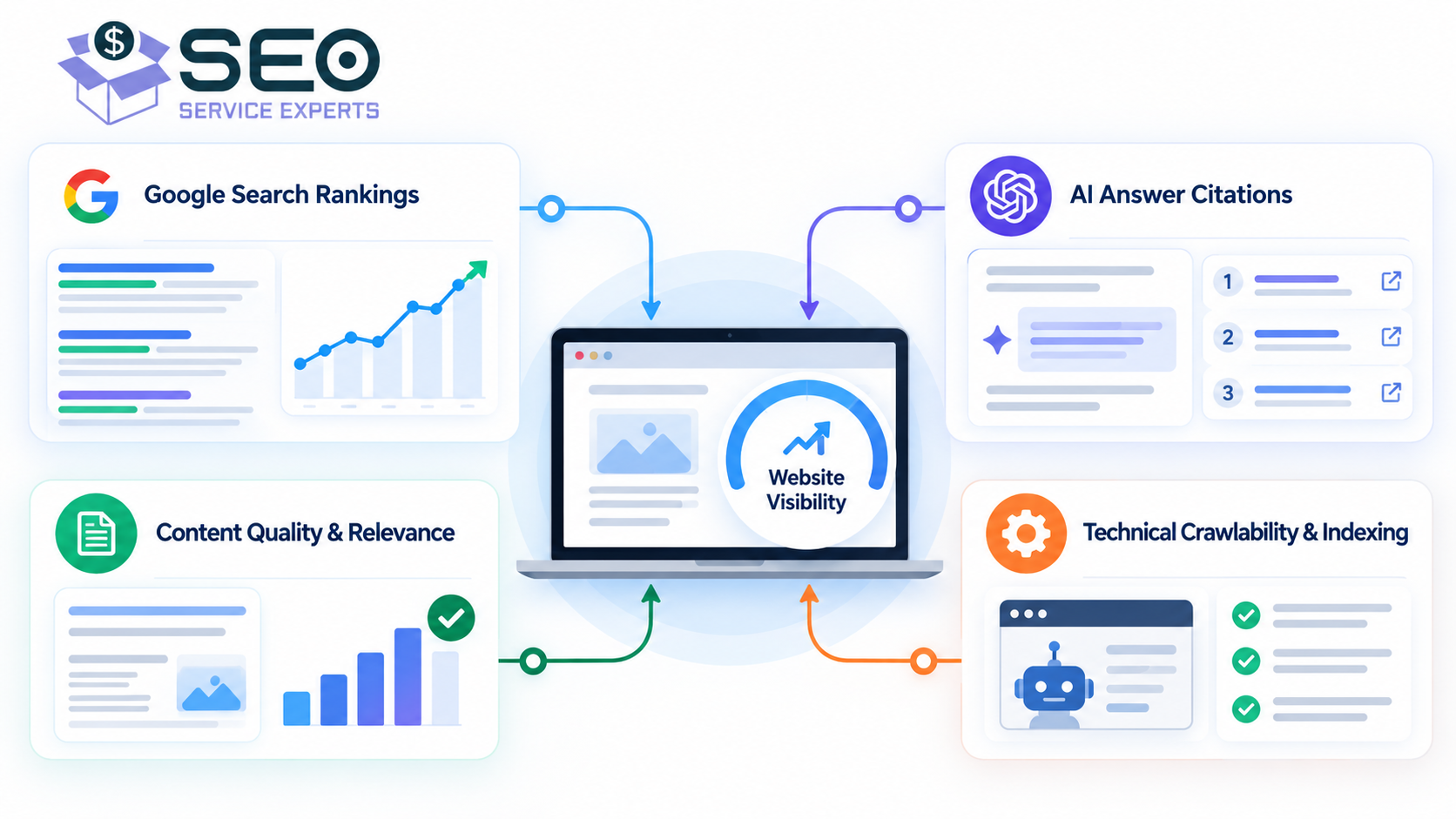
Your website can rank well on Google without appearing in AI-generated answers. Similarly, a page with lower organic rankings may be cited by an AI-powered search experience because it provides a direct answer, relevant evidence, or useful context.
This happens because traditional rankings and AI citations represent different visibility outcomes. Rankings indicate where a webpage appears in organic search results, while AI citations identify sources selected to support a generated response.
If you want your business to remain visible across both experiences, you need more than keyword rankings. You need relevant content, technical accessibility, clear explanations, and genuine expertise.
Google rankings and AI citations can diverge because users express different needs through their searches.
Someone searching for “SEO services” may want to compare agencies. Another person asking, “Why does my website rank on Google but not appear in AI answers?” needs a detailed explanation of a specific problem.
A commercial service page may satisfy the first search, while an informational article may better answer the second.
To address these differences:
Your goal is to match the content to the user’s actual need rather than targeting keywords without considering intent.
Traditional search rankings consider multiple signals related to relevance, quality, and usability. AI-powered search experiences also use retrieval and selection processes to identify information suitable for a particular response.
A page might rank well for a broad topic but lack the specific evidence needed to answer a detailed question. Another page may provide a clearer explanation or a more relevant example.
This is why you should not treat a first-page ranking as a guarantee of AI visibility.
To improve your overall search strategy, understand how SEO and GEO differ in modern search optimization. Both approaches complement each other, but neither guarantees a particular position or citation.
AI systems need to identify relevant information and understand its relationship to a user’s question. Content that hides its main answer beneath lengthy introductions can be difficult for readers to navigate.
Make your pages easier to understand by using:
Avoid creating unnecessary sections simply to include more keywords. Every heading should help readers understand the topic or solve a problem.
Clear structure benefits both human visitors and search systems without requiring a separate version of your content for AI.
Many websites publish similar SEO advice. If your content repeats common recommendations without adding useful insights, it gives readers fewer reasons to choose your page.
Strengthen your content with original research, first-hand experience, expert commentary, practical examples, and transparent explanations.
For example, instead of simply claiming that technical SEO improves visibility, explain how crawlability, indexing, canonical tags, and internal linking affect a website’s discoverability.
Support factual claims with reliable evidence, and never invent statistics or results.
Your content should demonstrate why your business understands the subject, not merely show that it can explain familiar concepts.
Even useful content can struggle to gain visibility if search systems cannot access or process it correctly.
Review your website for:
You should also maintain an XML sitemap containing the important, canonical URLs you want search engines to discover.
If your website has indexing or accessibility problems, review these technical SEO fixes for better crawling and indexing.
Structured data can help search engines interpret eligible content, but it does not guarantee rankings or AI citations. Focus on correct implementation and useful visible information rather than relying on technical shortcuts.
Generative Engine Optimization (GEO) focuses on improving the potential visibility of information within AI-generated answers and other generative search experiences.
However, GEO should not replace established SEO practices. A more sustainable strategy combines both approaches.
Start with these actions:
For a deeper understanding of this approach, explore Generative Engine Optimization strategies for AI search visibility.
Google Search Console can help you monitor organic impressions, clicks, click-through rates, and average positions. Use this information to identify pages and queries that need improvement.
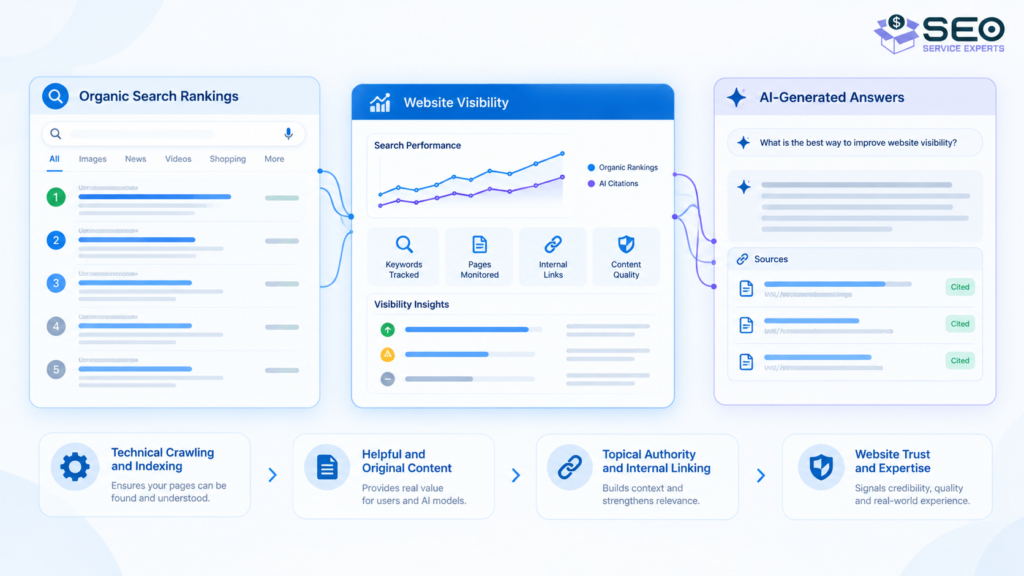
AI citation monitoring requires a separate approach. Test relevant questions across the AI search experiences that matter to your audience and record which sources appear. Repeat the checks over time because results can vary by question and context.
Where reliable data is available, monitor referral traffic from AI platforms and evaluate whether it generates qualified enquiries or sales.
Do not assume that every citation produces a website visit. Likewise, do not judge content quality solely by the number of citations it receives.
A balanced measurement strategy considers visibility, engagement, qualified traffic, and business outcomes.
Google rankings and AI citations often diverge because appearing in organic search results and being selected as a source for a generated answer are different outcomes.
Strong SEO remains an important foundation, but your strategy should also prioritize direct answers, original information, trustworthy content, technical accessibility, and relevant topic coverage.
If your website ranks on Google but struggles to gain broader search visibility, contact SEO Services Experts for professional SEO guidance to identify content gaps and opportunities for improvement.
Frequently Asked Questions
Why can a lower-ranking page receive an AI citation?
A lower-ranking page may provide a more relevant explanation, useful evidence, or a clearer answer to a specific question. AI citation selection varies by query and platform.
Do higher Google rankings guarantee AI citations?
No. Strong organic rankings can support discoverability, but they do not guarantee that a webpage will appear in AI-generated answers.
Does GEO replace traditional SEO?
No. GEO complements SEO by focusing on visibility within generative search experiences while retaining established technical and content optimization practices.
How can I improve AI search visibility?
Publish accurate, original, well-structured content, answer relevant questions clearly, strengthen technical accessibility, and demonstrate genuine expertise.
How should businesses measure AI citations?
Monitor relevant queries across selected AI search experiences, record cited sources, and evaluate available referral traffic alongside organic performance and conversions.