
How Does Query Fan-Out Change SEO Content Architecture?
Oct 30, 2026
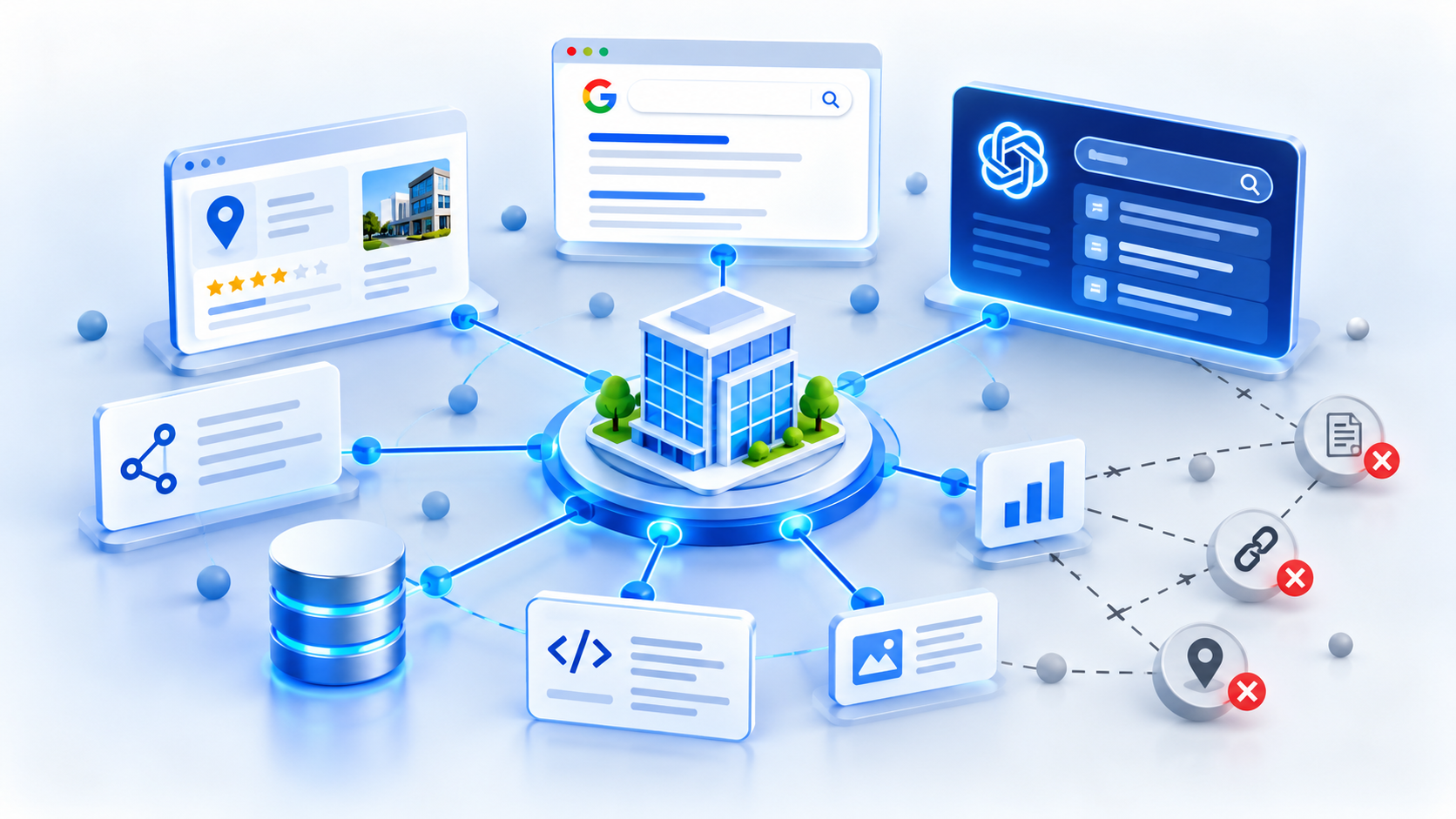
Google AI search experiences are changing how people discover businesses, compare services, and evaluate brands. Traditional SEO rankings remain important, but your website also needs to communicate a clear and consistent identity across relevant online sources.
This is where brand entity gaps become important. If your business name, services, expertise, and external references are incomplete or inconsistent, search systems may have difficulty distinguishing your brand from similar businesses. That does not automatically prevent your content from appearing in AI-generated answers, but it can make your brand’s identity and relevance harder to establish.
Understanding these gaps helps you strengthen your digital presence and build a more reliable foundation for AI search visibility.
A brand entity is a recognizable business or organization that search systems can distinguish from other entities. Its identity may be associated with a business name, website, services, location, leadership, industry, and relevant external references.
Brand entity gaps occur when important information about your business is missing, contradictory, outdated, or poorly connected across these sources.
For example, imagine your company offers technical SEO, content optimization, and AI search optimization. Your homepage describes only general digital marketing services, your business profiles contain outdated information, and your blog rarely connects your brand with its areas of expertise.
Your website may still rank for relevant keywords. However, the overall information available about your business may not communicate its complete identity clearly.
Closing these gaps is an important part of a broader expert SEO content strategy.
Google uses information from websites and other sources to understand organizations and their relationships. Its official documentation explains that Organization structured data can help Google understand administrative details and distinguish one organization from another.
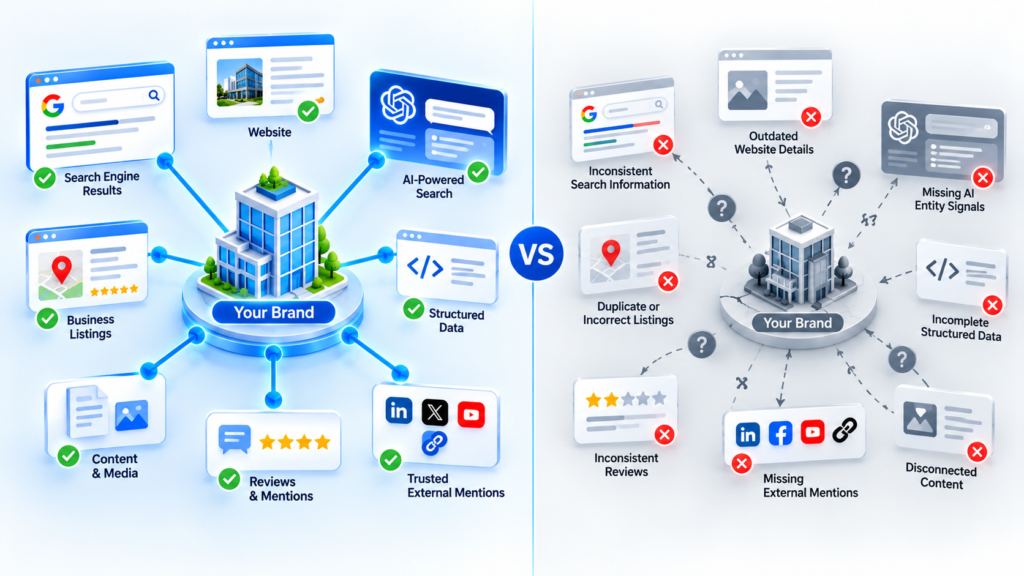
Although this does not guarantee AI citations, clear brand information can support better identification and interpretation of your business.
Your brand name should be represented consistently across your website, business profiles, author pages, and relevant directories.
Problems can arise when your website uses one company name, social profiles use another variation, and third-party listings contain outdated contact details or descriptions.
These differences do not automatically damage rankings. However, when they make it difficult to determine whether multiple references describe the same organization, they can complicate entity identification.
How to fix it: Standardize your business name, official website URL, logo, company description, and contact information. Update important profiles and correct outdated references wherever possible.
A business may publish useful articles without clearly establishing which services it provides or what expertise it represents.
For example, a website might publish content about technical SEO, semantic search, and generative engine optimization without explaining how these topics connect to its actual services.
This creates a gap between informational content and commercial identity.
How to fix it: Build clear relationships between your homepage, service pages, company information, and supporting articles. Explain what you do, which problems you solve, who you serve, and how your services relate to the subjects covered in your content.
Relevant internal links can reinforce these connections for users and help search systems discover related pages.
Structured data provides standardized information that helps search engines interpret webpage content. For organizations, useful properties can include the official name, URL, logo, description, and relevant profile links.
If this information is missing or inaccurate, search engines may have fewer explicit clues about your organization.
However, structured data is not a shortcut to AI visibility. Google does not guarantee that implementing markup will produce a particular search feature or citation.
How to fix it: Review Google’s Organization structured data guidelines. Add accurate Organization markup to your homepage or appropriate company information page, use a representative logo, and connect official profiles through relevant sameAs properties.
Only include information that is accurate and supported by the visible content of your website.
Your website can explain your expertise, but relevant external sources may provide additional context about your business.
When your brand has few credible mentions outside its own website, there may be less independent information available to corroborate its identity, expertise, or industry associations.
The objective is not to accumulate mentions indiscriminately. Low-quality directories, paid placements without editorial value, and irrelevant backlinks do not automatically strengthen brand recognition.
How to fix it: Pursue relevant industry publications, expert commentary, legitimate business directories, professional partnerships, and original research that other publishers may reference. Make sure the information accurately identifies your company and links to the appropriate website when useful.
Your service pages may describe your current offerings while older articles refer to discontinued services or outdated business positioning.
This creates conflicting signals about what your brand does today.
A large content library can also become difficult to interpret when articles repeat similar information without connecting related concepts.
How to fix it: Audit existing content for outdated claims, overlapping topics, broken links, and inconsistent service descriptions. Update useful pages, consolidate genuinely redundant content where appropriate, and connect supporting articles to relevant service pages.
A structured website makes it easier for visitors to understand your expertise and find the information they need.
You do not need to guess whether your brand has an entity problem. Start with a practical audit.
Search for your exact business name, common variations, and brand name combined with your main services.
Review whether the results consistently identify the correct company. Look for outdated profiles, unrelated businesses with similar names, incorrect descriptions, and missing official pages.
Check your homepage, About page, service pages, professional profiles, and important business listings.
Confirm that the company name, website, services, and other relevant details are accurate and consistent.
Test a range of relevant queries across available AI-powered search experiences.
For example:
Record whether your brand appears, whether its services are described correctly, and whether the information is supported by relevant sources.
Repeat the checks periodically because AI-generated answers can vary between queries and over time. A single missing citation does not prove an entity gap.
Review whether important pages can be crawled and indexed, whether canonical URLs are correct, and whether internal links connect relevant content.
You can use technical SEO issue fixes as a starting point for identifying problems that may prevent important information from being discovered.
Technical accessibility and brand clarity are different issues, so evaluate them separately.
A structured approach combines brand consistency, useful content, technical accuracy, and credible external references.
First, clarify your brand identity. Define your official business name, primary services, target audience, and key areas of expertise.
Second, strengthen your website’s entity information. Keep your About page, homepage, service descriptions, and organization markup aligned with your actual business.
Third, develop connected topical content. Publish original articles that answer specific customer questions and link naturally to relevant supporting resources and service pages.
Fourth, improve external corroboration. Maintain accurate business profiles and pursue genuine mentions from relevant industry sources.
Finally, measure changes over time. Monitor brand-related search impressions, organic traffic, referral visits, branded queries, and AI answer visibility across a consistent set of relevant prompts.
SEO Services Experts can help businesses evaluate these areas as part of a comprehensive strategy for stronger organic discovery and clearer brand positioning.
Explore Our Expert SEO Services
A brand entity gap is missing, inconsistent, or poorly connected information that makes it harder to establish a clear understanding of a business across its website and other online sources.
They may contribute to weaker brand recognition or less accurate descriptions, but they are not a confirmed standalone Google ranking factor. AI visibility also depends on relevance, content quality, accessibility, and other signals.
Organization schema can help Google interpret company information and distinguish organizations. However, it does not guarantee higher rankings, AI citations, or inclusion in AI-generated answers.
Test relevant prompts across AI-powered search experiences, document brand mentions and source citations, and repeat the checks consistently. Compare the results with organic search performance and brand-related queries.
The timeline depends on the issues involved, the speed of website updates, external profile corrections, and how quickly search systems revisit the information. Improvements are not guaranteed and should be measured over time.
Your brand needs more than keyword rankings to establish a clear digital identity. Consistent business information, connected content, accurate structured data, and credible external references can help search systems better understand what your company offers.
Identify the gaps first, prioritize corrections that improve accuracy, and measure whether your brand becomes easier to discover and understand across search experiences. For a strategy tailored to your website, Contact Us to discuss your SEO and AI search visibility goals.