

How Does Query Fan-Out Change SEO Content Architecture?
Oct 30, 2026

As AI-powered search changes how people discover information, publishing high-quality content is no longer the only challenge. Your website also needs to make its information accessible, understandable, relevant, and useful to search systems that generate answers from multiple sources.
This creates a new SEO challenge: content retrieval gaps. These occur when your website contains relevant information, but AI-driven search experiences do not appear to retrieve, recognize, or reference it for relevant queries.
For businesses investing in organic visibility, identifying these gaps can reveal opportunities to improve content structure, technical accessibility, topical coverage, and search relevance. SEO Services Experts can approach this challenge by combining traditional SEO analysis with AI search visibility monitoring and structured content evaluation.
AI search content retrieval gaps occur when a webpage contains useful information about a topic but does not appear to be surfaced or referenced in relevant AI-generated answers.
For example, imagine your website publishes a detailed guide about technical SEO audits. Your page may rank for several traditional Google searches, yet AI-powered search experiences may reference competing sources when users ask questions about crawl errors, indexing problems, or website performance.
This does not automatically mean your content is poor. The cause could involve technical accessibility, incomplete topic coverage, unclear answers, competing pages, or differences between the user’s question and the information your page provides.
It is also important to distinguish a genuine retrieval gap from a measurement limitation. AI responses can vary by query, context, location, and time. A single missing citation does not prove that a page cannot be retrieved.
The first step is to compare your existing organic search performance with your visibility in relevant AI-generated answers.
Use Google Search Console to identify queries, pages, impressions, clicks, and average positions. Then test representative questions across AI search experiences that provide source citations.
For example, evaluate queries such as:
Record whether your website appears as a cited source, which competing websites appear, and what information those sources contribute.
If your page performs well in conventional search but rarely appears in relevant AI answers, investigate further rather than assuming that rankings guarantee AI visibility.
For a broader understanding of this changing landscape, review the guide to generative engine optimization and AI search visibility.
AI search systems may respond to complex questions by considering several related aspects of a topic. If your content answers only the main question but overlooks important supporting questions, competing sources may provide more useful information for the query.
SEO experts should examine the relationship between the primary topic and its supporting subtopics.
For example, an article about technical SEO might need to address:
Compare your page with the questions users ask and the information appearing in relevant AI answers. Look for missing explanations, unsupported claims, outdated examples, and questions that your competitors address more effectively.
A structured content strategy for improving organic search performance can help you organize these findings into a connected content plan.
The goal is not to make every article longer. It is to ensure each page addresses its intended topic with enough depth and clarity.
Before rewriting content, confirm that technical issues are not limiting its discoverability.
SEO experts should inspect important URLs using crawling tools, Google Search Console, server logs where available, and rendered-page testing. These checks can reveal whether pages are accessible to search engine crawlers and eligible for indexing.
Review the following areas:
These checks help identify conventional technical SEO problems that may also affect content discovery.
However, do not assume that a page being indexed guarantees its selection in AI-generated answers. Indexing, retrieval, and citation are different processes, and search platforms do not disclose every detail of their selection systems.
For a deeper diagnostic process, use this guide to fix technical SEO issues affecting crawling and indexing.
A page might appear in response to one question but not another question with similar meaning. SEO experts can investigate this by testing a consistent set of query variations.
For example, if your page covers AI search optimization, test questions such as:
Record the results across multiple testing sessions. Note which sources appear, what information they contribute, and whether your page provides a stronger or weaker answer to each question.
Use a simple tracking spreadsheet with columns for the query, platform, date, cited sources, relevant webpage, and observed content gap.
Avoid treating a single response as definitive evidence. AI-generated answers can vary, and different platforms may use different retrieval methods, indexes, and source-selection processes.
The objective is to identify repeatable patterns rather than chase individual citations.
Even when a webpage contains the right information, unclear organization can make important details harder for readers and automated systems to interpret.
SEO experts should check whether each page has a clear purpose, descriptive headings, direct explanations, and logically connected sections.
Consider these improvements:
Answer the main question early. Provide a concise explanation before expanding into supporting details.
Use specific headings. Describe the actual question or concept covered in each section instead of relying on vague headings.
Define specialized terms. Explain technical concepts when they first appear so the page remains understandable to different audiences.
Support important claims. Include credible references, relevant examples, original research, or practical evidence when appropriate.
Keep related information connected. Organize sections so readers can follow the explanation without jumping between unrelated ideas.
These practices improve usability and make your content easier to evaluate. They do not guarantee AI citations, but they help create a clearer and more useful resource.
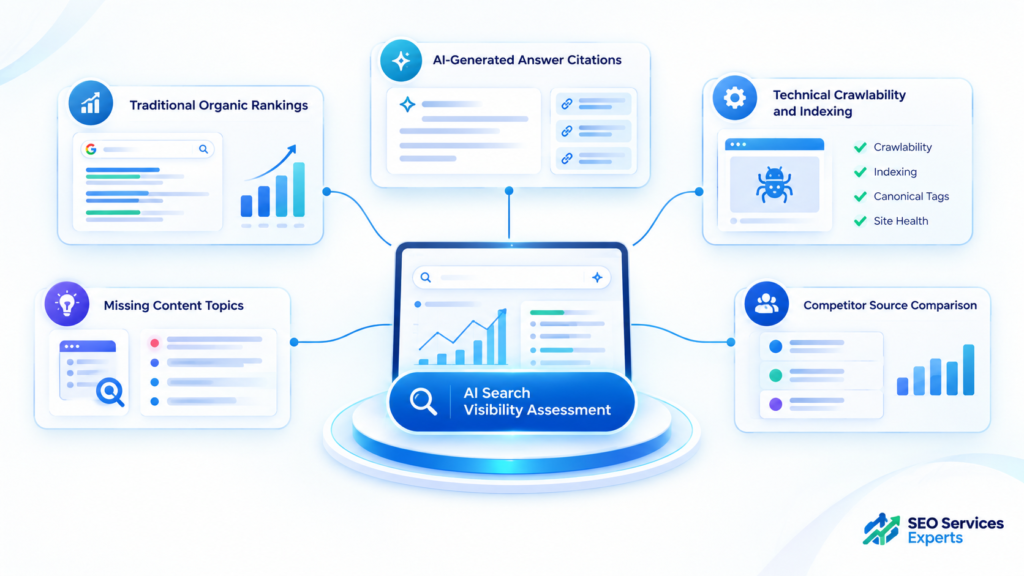
An effective audit turns observations into prioritized actions. Rather than relying on a single AI visibility score, SEO experts should combine several sources of evidence.
| Audit area | What to investigate |
| Organic visibility | Relevant queries, impressions, clicks, and ranking trends |
| AI citations | Whether your pages appear in sampled AI answers |
| Technical health | Crawling, indexing, rendering, and canonicalization |
| Content coverage | Missing questions, explanations, and supporting subtopics |
| Competitor sources | What useful information competing pages provide |
| Business outcomes | Qualified visits, leads, and conversions |
Use these findings to classify each issue as technical, content-related, topical, or measurement-related.
For instance, a page that is inaccessible to crawlers requires a different solution from an accessible page that does not answer a specific question clearly.
Prioritize problems according to business importance, the strength of the evidence, and the effort required to fix them.
After making changes, repeat the same query tests and monitor organic performance. This creates a feedback loop for continuous improvement.
While investigating AI search retrieval gaps, avoid these common errors:
Instead, use evidence to determine whether the real issue involves technical access, content relevance, information quality, or limitations in your measurement process.
It is a potential mismatch between relevant information available on a website and the content surfaced in relevant AI-generated answers. Further investigation is needed to establish the likely cause.
Yes. Traditional rankings and AI citations are different outcomes. A page may rank organically without being selected as a source for a particular AI-generated response.
Google Search Console, website crawlers, analytics platforms, server logs, and AI visibility monitoring tools can provide complementary evidence. No single tool reveals every platform’s internal retrieval process.
Structured data can help describe page content and entities, but it does not guarantee AI citations. Implement appropriate markup accurately and prioritize useful, accessible content.
Review important queries regularly and repeat tests after significant content or technical changes. Monthly reviews can provide a practical starting point, adjusted to your website’s size and search volatility.
Detecting AI search content retrieval gaps requires more than checking whether your brand appears in an AI-generated answer. You need to investigate technical accessibility, query relevance, missing subtopics, content clarity, and differences between traditional search performance and AI citations.
By combining repeatable query testing with technical audits and content analysis, you can identify practical improvements instead of making assumptions about how AI search works.
For businesses adapting to evolving search experiences, SEO Services Experts can help connect technical SEO, content strategy, and AI search visibility into a measurable optimization process.
If you want to identify the content and technical issues limiting your website’s search visibility, contact our SEO team for a tailored optimization assessment.