

SEO vs GEO: What’s the Difference?
Sep 15, 2026
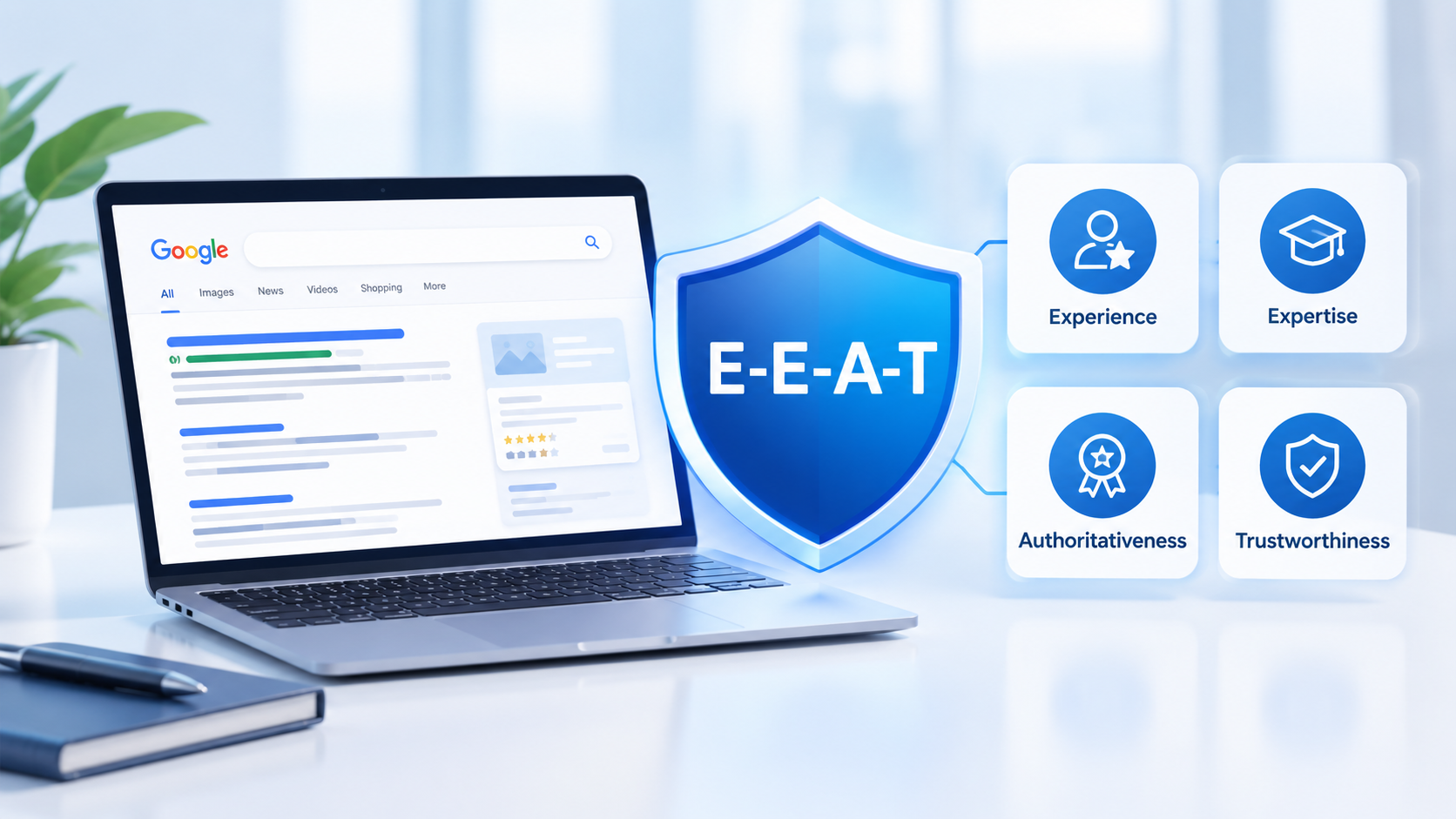
When you want your website to perform well in organic search, publishing content is only one part of the process. Your content also needs to demonstrate real experience, knowledge, authority, and trust. This is where E-E-A-T in SEO becomes important.
E-E-A-T stands for Experience, Expertise, Authoritativeness, and Trustworthiness. These concepts help you understand what makes online content more credible and useful to people.
Whether you run a business website, e-commerce store, service website, or professional blog, strengthening E-E-A-T can help you create content that users are more likely to trust and engage with.
E-E-A-T represents four important qualities:
These four elements work together. A website may have excellent expertise but still struggle to build trust if its business information is unclear. Similarly, an experienced writer may create useful content, but strong authority requires broader recognition and credibility.
Experience focuses on whether the content demonstrates genuine involvement with the topic.
For example, if you write about website maintenance, explaining what you have actually learned from maintaining websites can make the information more useful. Practical examples, case studies, original observations, and real-world lessons can demonstrate experience.
You can strengthen this aspect by:
Instead of creating generic information, focus on what your audience can actually learn from your experience.
Expertise refers to the depth and accuracy of knowledge demonstrated by your content.
Your website should make it easy for readers to understand why they should trust the information you publish. Author biographies, professional credentials, relevant experience, detailed explanations, and accurate references can all contribute to this impression.
To demonstrate expertise, you can:
Expertise is not simply about using complicated terminology. Strong expertise is often demonstrated by your ability to explain a subject accurately and clearly.
Authority develops when people and organizations recognize your website, brand, or authors as credible sources of information.
You can build authority through consistent publishing, industry relationships, quality backlinks, positive mentions, professional profiles, and useful resources.
For example, a business that consistently publishes valuable information about its industry can gradually become a recognizable resource within that niche.
Ways to strengthen authority include:
Authority is usually built over time. It is not something you can establish through a single article.
For a deeper look at building SEO authority in competitive niches, consider how consistent content, relevant backlinks, and industry recognition work together.

Trust is arguably the most important part of E-E-A-T because users need confidence in both your content and your business.
Your website should clearly communicate who operates it, what the business does, and how visitors can contact you.
Important trust elements include:
Avoid making exaggerated promises or publishing information that cannot be supported. Transparency creates a stronger foundation for long-term credibility.
Understanding E-E-A-T in SEO helps you focus on more than keywords and rankings. Modern SEO requires you to consider whether your website provides information people can genuinely trust and use.
Strong E-E-A-T can support:
E-E-A-T should therefore be considered as part of your overall SEO and content strategy rather than treated as a separate task.
Search behavior has become more sophisticated. People expect websites to provide useful answers instead of pages created simply to attract clicks.
This makes several areas particularly important:
Your content should answer the question behind the search rather than simply repeating a keyword. A clear search intent and topical SEO strategy helps align content with what users actually need.
Covering related subjects comprehensively can help demonstrate that your website has meaningful knowledge about a particular topic.
Well-researched, original, useful content gives visitors a reason to stay, learn, and return.
Even excellent content can lose credibility when the website is difficult to navigate, overloaded with intrusive elements, or technically frustrating. Strong website user experience and SEO optimization helps make important content easier to use.
Use related concepts and terminology naturally so readers can understand the subject completely without unnecessary keyword repetition.
Improving E-E-A-T is an ongoing process. You can start with several practical steps.
Share real examples, processes, lessons, and observations rather than relying entirely on generic explanations.
Introduce the people responsible for creating important content. Mention relevant professional experience, qualifications, and areas of specialization.
Review older articles periodically. Correct outdated information, update statistics, improve explanations, and remove information that is no longer accurate.
When making factual or technical claims, support them with credible sources where appropriate.
Focus on earning recognition from relevant websites, publications, organizations, and industry communities rather than pursuing random links.
Include clear About Us and transparent business information, Contact, Privacy Policy, and other relevant business information so visitors understand who is behind the website.
Authentic customer feedback can help demonstrate that your business has real-world experience serving its audience.
Use HTTPS and maintain a technically reliable website. Visitors should feel comfortable interacting with your pages.
You can also review schema markup and structured data for search visibility when relevant to your page type. A structured technical SEO audit for crawling, indexing, and performance can uncover issues that affect website reliability.
E-E-A-T can apply to almost every website, but the implementation may vary.
Show your experience, services, team expertise, customer results, and business information.
Provide accurate product descriptions, transparent policies, customer reviews, shipping information, and clear business details.
Explain your process, experience, qualifications, case studies, and customer outcomes.
Use knowledgeable authors, reliable sources, original research, and clear editorial standards.
Show real business information, customer experiences, service areas, staff expertise, and authentic reviews.
Several mistakes can weaken the credibility of your website.
Readers may have difficulty evaluating content when they cannot identify who created it or why that person is qualified to discuss the subject.
Avoid promising unrealistic results or making statements that cannot be verified.
Simply rewriting information already available online does not demonstrate strong experience or unique value.
Old statistics, expired recommendations, and inaccurate information can reduce user confidence.
Reviews should represent genuine customer experiences. Artificial testimonials can damage trust and reputation.
A website without clear ownership or contact information may appear less trustworthy.
Traditional SEO often focuses on areas such as keywords, technical performance, internal linking, crawlability, and backlinks.
E-E-A-T adds another important perspective: Why should people trust this content and the source behind it?
The two approaches should work together.
Technical SEO can help search engines access and understand your website, while high-quality content and strong credibility can help users find greater value in what you publish. This is why content strategy and SEO optimization for higher organic traffic should connect technical foundations with content quality.
Improving E-E-A-T often requires more than making a few changes to individual pages. You need to evaluate content, technical SEO, authority, reputation, and user experience together.
Working with expert SEO services for improving website authority and organic growth can help you develop a structured strategy around these areas.
A professional SEO approach can help identify:
The goal is not to manipulate search results. It is to create a website that genuinely deserves attention because it provides useful and credible information.
A strong E-E-A-T strategy should be based on your website’s specific industry, audience, content, and business objectives.
Trusted SEO Experts for developing a stronger E-E-A-T strategy can evaluate how experience, expertise, authority, and trust are represented throughout your website.
A practical evaluation may include:
This approach helps you build credibility as part of a broader SEO strategy.
Use this checklist to evaluate your website:
The more consistently you address these areas, the stronger your overall credibility strategy can become.
If you want to start improving your website today, begin with the pages that matter most.
First, identify your most important commercial and informational pages. Review whether each page clearly communicates who created the content, what makes the information useful, and why visitors should trust your business.
Next, improve weak sections with original examples, stronger explanations, updated information, and relevant supporting evidence.
Finally, review your website as a real visitor would. Ask yourself:
Can I understand who created this content?
Can I verify important claims?
Does this business appear legitimate and transparent?
Does this page provide enough value to solve my problem?
These questions can reveal opportunities that a simple keyword audit may overlook.
A comprehensive SEO strategy should connect content quality with technical performance, authority, user experience, and business credibility.
For businesses that want a structured approach, SEO Services Experts for building long-term search visibility can help identify opportunities to strengthen website quality and develop a sustainable organic search strategy.
The objective should always be to create a website that is useful to visitors first while making its expertise and credibility clear.
E-E-A-T stands for Experience, Expertise, Authoritativeness, and Trustworthiness. It is a framework used to understand important qualities of high-quality content and credible websites.
E-E-A-T helps you focus on creating content that demonstrates real experience, knowledge, authority, and trust. These qualities can support stronger content quality, user confidence, and long-term search visibility.
The four parts are Experience, Expertise, Authoritativeness, and Trustworthiness. Together, they help describe whether content and its source demonstrate practical experience, knowledge, credibility, and reliability.
You can improve E-E-A-T by publishing original content, demonstrating first-hand experience, adding author information, using reliable sources, keeping content updated, building legitimate authority, and providing transparent business information.
E-E-A-T should not be treated as a single ranking factor. Instead, it represents important qualities associated with helpful, credible, and trustworthy content that can contribute to a stronger overall SEO strategy.
E-E-A-T adds Experience to the original E-A-T concept. It recognizes the value of first-hand experience alongside Expertise, Authoritativeness, and Trustworthiness.
Experience can make content more useful by adding original insights, practical examples, real-world observations, case studies, and lessons that generic content may not provide.
A website can build trust by providing accurate information, clear business and contact details, secure browsing, genuine reviews, transparent policies, knowledgeable authors, and content that avoids misleading claims.
Authors can demonstrate expertise through relevant qualifications, professional experience, detailed explanations, original insights, accurate information, and a clear author profile that establishes their background.
Yes. Small businesses can demonstrate E-E-A-T by highlighting their real-world experience, showcasing customer results, publishing useful content, providing accurate business information, collecting genuine reviews, and explaining their expertise clearly.
E-E-A-T in SEO is ultimately about credibility. Your website should not only provide information but also make it clear why that information deserves attention.
By demonstrating genuine experience, showing relevant expertise, building authority, and maintaining strong trust signals, you can create a more credible online presence.
E-E-A-T should not be treated as a one-time optimization task. Review your content, authors, business information, reputation, and user experience regularly. As your website grows, continue improving the areas that help visitors understand and trust your brand.
If you want to turn these principles into a practical SEO strategy, take the next step with a customized approach focused on stronger credibility and sustainable organic visibility.