

What Is E-E-A-T in SEO? A Complete Guide to Building Search Trust
Sep 22, 2026
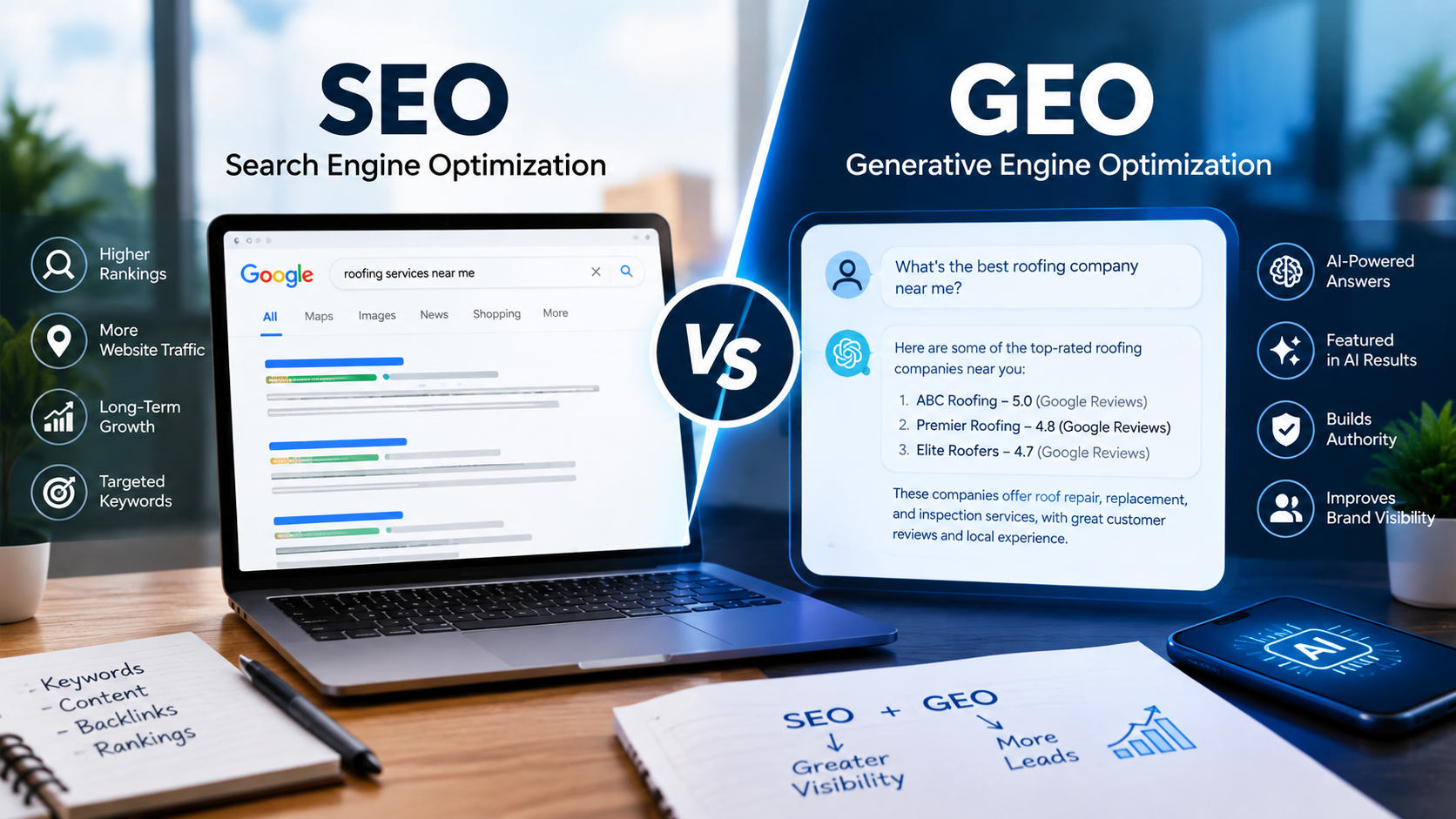
Search is evolving quickly. People are no longer relying only on traditional search-result pages to find information. Modern search experiences can provide summarized answers, supporting sources, follow-up exploration, and more conversational ways to discover information.
This change has made Generative Engine Optimization (GEO) an important topic for businesses that want to remain visible as search evolves. But does GEO replace SEO?
No.
In fact, Google’s latest guidance makes the relationship clearer: foundational SEO practices remain relevant because generative search features rely on Google’s core ranking and quality systems.
So, what exactly is the difference between SEO and GEO, and how should you approach both in 2026?
Search Engine Optimization (SEO) is the process of improving your website so search engines can discover, understand, evaluate, and rank your content for relevant searches.
A complete SEO strategy can include:
The primary goal is to increase your website’s visibility when people search for information, products, services, or solutions related to your business.
For example, if you provide SEO services, your strategy may target informational searches such as “how to improve website rankings” as well as commercial searches related to professional SEO services for stronger search visibility.
A strong SEO foundation is also useful beyond traditional rankings because Google’s generative search features use core Search systems to retrieve relevant information.
Generative Engine Optimization (GEO) refers to strategies intended to improve the visibility of your information, website, brand, or expertise within generative search experiences.
Instead of concentrating only on where a webpage appears in traditional results, GEO considers how information may be discovered, understood, retrieved, and presented within generated responses.
This makes the following qualities particularly valuable:
However, GEO should not be treated as a collection of secret hacks.
Google’s latest guidance specifically addresses common GEO/AEO misconceptions and says that website owners should prioritize established SEO best practices rather than unsupported tactics designed only for generative search.
The simplest way to understand SEO vs GEO is:
SEO focuses on improving overall search visibility, while GEO focuses more specifically on visibility within generative search experiences.
There is considerable overlap between the two.
| SEO | GEO |
| Focuses on overall search visibility | Focuses on generative-search visibility |
| Optimizes websites and webpages | Optimizes information for understanding and retrieval |
| Uses keywords and search intent | Emphasizes context, relevance, entities, and questions |
| Measures rankings, clicks, traffic, and conversions | Can also consider generated-search visibility and brand mentions |
| Depends on technical and content quality | Also depends heavily on technical and content quality |
Therefore, you shouldn’t think of SEO and GEO as two completely separate marketing disciplines.
One of the most important 2026 updates is Google’s clarification that SEO remains relevant for generative search.
Google explains that its generative AI features in Search are based on its core ranking and quality systems. These experiences use AI techniques to retrieve and present relevant information from the Search index.
That means you shouldn’t abandon:
Instead, strengthen these fundamentals while making your content clearer, more useful, and more comprehensive.
This is why businesses investing in SEO Services Experts should think beyond traditional rankings and build a website that can support different forms of search visibility.
Generative search has changed the way users can interact with search.
Instead of entering one short query and opening several pages, users can increasingly receive an overview and continue exploring through additional questions.
For example, a user may search:
“What is technical SEO?”
Then ask:
“Why is technical SEO important for ecommerce?”
And continue with:
“Which technical issues should I fix first?”
This creates a more conversational and exploratory search journey.
Google’s current documentation specifically covers generative features such as AI Overviews and AI Mode and explains how website owners should approach visibility within these experiences.
Your content should therefore answer the main question while also providing useful context for related questions.
Traditional SEO often starts with keyword research.
You identify:
GEO encourages you to think beyond exact keyword matching.
Instead of creating separate thin pages for every small keyword variation, you can build comprehensive resources around broader topics and user needs.
For example, instead of creating disconnected pages for:
you can develop a useful resource covering what an SEO audit is, why it matters, what it examines, common problems, and when professional support is appropriate.
Google’s current guidance says you don’t need to create content for every possible query variation or write specifically for generative systems. Its systems can understand related language and meaning.
Search intent has always been an important SEO principle.
You need to understand whether your audience wants to:
Once you understand the intent, create content that directly satisfies it.
A page that genuinely answers the user’s question is much more valuable than a page that simply repeats the target keyword.
This is where Trusted SEO Experts can help businesses develop content strategies based on actual user needs rather than keyword volume alone.
Good SEO content and useful GEO-oriented content have substantial overlap.
Explain important concepts directly and avoid unnecessary complexity.
Cover the topic sufficiently to answer the user’s primary question and important related questions.
Use descriptive headings, short paragraphs, lists, tables, and clear transitions.
Provide information, experience, examples, or insights that aren’t simply copied from common sources.
Support important claims with reliable evidence and demonstrate genuine expertise.
Where appropriate, include real-world examples, processes, observations, and practical recommendations.
Google’s 2026 guidance emphasizes creating unique, useful, reliable, non-commodity content for people.
Modern search isn’t only about individual keywords.
Search systems also need to understand relationships between:
For example, your website should make it clear:
Consistent information across your website and legitimate external sources can strengthen this context.
Instead of optimizing every page around an isolated phrase, build a clear connection between your brand, services, expertise, and topics.
Publishing more pages doesn’t automatically increase visibility.
Google’s latest guidance specifically emphasizes unique, useful, non-commodity content. The focus should be on providing something genuinely valuable to your audience rather than simply producing more pages.
Your content can become more valuable through:
This creates a stronger reason for users to trust and engage with your website.
Structured data can still be useful for SEO, but you shouldn’t assume that adding schema automatically makes your content appear in generative answers.
Google’s current guidance states that structured data isn’t required specifically for generative AI search features. However, accurate structured data can still support eligible Search features and remains part of a broader SEO strategy.
Therefore:
Use relevant structured data correctly, but don’t treat it as a GEO shortcut.
This is another important 2026 clarification.
Google’s updated documentation addresses llms.txt and makes clear that website owners don’t need to create this file specifically to appear in Google’s generative search features.
Rather than spending significant resources on unsupported GEO tactics, prioritize:
These fundamentals provide more sustainable value.
You may see claims that getting large numbers of online mentions will automatically improve generative visibility.
You shouldn’t rely on that approach.
Google’s current guidance warns against tactics intended to manipulate generative search visibility, and its spam policies apply to attempts to manipulate generative AI responses as well as traditional Search.
Instead, build genuine authority through:
The goal should be genuine recognition, not artificial signals.
GEO does not make technical SEO irrelevant.
Your website still needs to be accessible and understandable.
Pay attention to:
If important content cannot be properly accessed or understood, it becomes harder for search systems to use that information.
You may also encounter AEO, or Answer Engine Optimization.
These terms are often used differently across the SEO industry.
A simple way to understand them is:
However, there is significant overlap.
Google’s current documentation explicitly explains that, from Google’s perspective, optimizing for generative AI search is still optimizing for the search experience—and therefore remains SEO.
Instead of maintaining completely separate SEO and GEO campaigns, you can create one integrated search strategy.
Identify your audience’s questions, problems, concerns, and buying considerations.
Understand whether each topic is informational, commercial, navigational, or transactional.
Create connected content around your major services and areas of expertise.
Make sure important content can be crawled, indexed, and understood.
Add practical insights, examples, experience, research, or useful data.
Provide direct answers instead of forcing users to search through unnecessary paragraphs.
Connect related pages to improve navigation and establish topical relationships.
Demonstrate expertise through valuable content and legitimate industry recognition.
Review important pages when information, services, products, or industry practices change.
For example, if search performance changes after a major algorithm update, reviewing what to do after a Google Core Update can help you evaluate content quality, technical issues, E-E-A-T, and other potential ranking factors.
Track traditional organic performance along with emerging generative-search visibility signals where reliable data is available.
Traditional SEO metrics remain important:
But your reporting can also consider how your website performs in newer search experiences.
Google has clarified how AI Overviews are represented in Search Console and has updated its documentation around AI Mode and generative-search performance. In April 2026, Google also noted that AI Mode data counts toward overall Search Console totals.
This means you should avoid evaluating search success through rankings alone.
Search visibility doesn’t always result in an immediate website visit.
A user may discover your business, learn about a topic, or become familiar with your brand without clicking a traditional result.
Therefore, consider a broader set of outcomes:
Your goal shouldn’t simply be:
“How can I get more clicks?”
A better question is:
“How can I become a useful and trustworthy source when my audience searches for this topic?”
Another useful 2026 development is Google’s Preferred Sources feature.
Google’s documentation says selected sites can receive a preferred badge in certain Search experiences, including AI Mode and AI Overviews, where the feature is available.
This reinforces the importance of building a credible publication or business website that users genuinely want to rely on.
Rather than trying to manipulate visibility, focus on becoming a source that your audience recognizes and trusts.
Repeating a phrase excessively doesn’t make content more authoritative.
Your content should primarily satisfy real users.
More pages don’t automatically create more authority.
Manipulative reputation-building can create quality and spam risks.
Don’t assume files such as llms.txt are mandatory for generative visibility.
Schema should be accurate and relevant rather than added simply as a GEO tactic.
Generative search doesn’t eliminate crawlability, indexability, site architecture, or performance.
Search visibility is becoming broader than one traditional ranking position.
Google’s current spam policies explicitly cover attempts to manipulate generative AI responses and scaled content created primarily to manipulate Search.
The real question isn’t whether you should choose SEO or GEO.
The better question is how effectively your website can serve users across different search experiences.
Your strategy should combine:
Working with SEO Services Experts can help you create a structured strategy that combines technical SEO, content optimization, search intent, topical authority, and modern search visibility.
Similarly, Expert SEO Services can help identify technical weaknesses, content gaps, authority opportunities, and areas where your website can provide more useful information to your target audience.
No. GEO is not replacing SEO.
Google’s current documentation is particularly clear on this point: its generative AI features are based on core Search ranking and quality systems, meaning established SEO best practices remain relevant.
Think of SEO as the foundation.
GEO is a way of thinking about visibility within newer generative search experiences.
A website with strong technical foundations, useful content, genuine expertise, topical relevance, and trustworthy information is better positioned to adapt as search continues evolving.
Search is becoming more conversational, contextual, and exploratory.
That means your long-term strategy should focus on durable principles rather than short-lived optimization tricks.
Prioritize:
Google’s 2026 guidance reinforces this approach by emphasizing useful, unique, non-commodity content and foundational SEO rather than separate GEO hacks.
The businesses that adapt successfully will be those that make their information genuinely useful, accessible, trustworthy, and easy to understand across changing search experiences.
SEO focuses broadly on improving search visibility, while GEO focuses more specifically on visibility within generative search experiences. However, the two overlap significantly because generative search also depends on strong technical SEO, quality content, relevance, and trustworthy information.
No. Google’s current guidance confirms that SEO best practices remain relevant for generative search features because these experiences rely on Google’s core Search ranking and quality systems. GEO should complement your overall SEO strategy rather than replace it.
No. Google doesn’t require special GEO code or a specific file such as llms.txt for inclusion in its generative search features. Strong technical SEO, crawlability, useful content, and clear site architecture remain important.
Structured data can support eligible Search features, but it isn’t a special requirement for generative search. You should implement relevant structured data accurately as part of your broader SEO strategy rather than treating it as a GEO shortcut.
Focus on technical accessibility, original and useful content, strong topical coverage, clear answers, accurate information, relevant internal linking, and genuine authority. Avoid unsupported tactics that promise guaranteed visibility in generated responses.
Yes. An integrated strategy makes more sense because strong SEO foundations can support visibility across traditional and generative search experiences. Your content, technical infrastructure, authority, and user experience can serve multiple search formats.
AEO generally focuses on providing direct answers, while GEO refers to optimization for generative search experiences. The terminology overlaps, and Google’s current guidance treats optimization for its generative Search experiences as part of the broader SEO process.
There is no fixed word-count requirement for generative search. Google specifically advises creating content for your audience rather than targeting a particular length for generative AI systems.
The SEO vs GEO debate can make these approaches appear more different than they really are. In practice, strong search visibility in 2026 starts with a solid SEO foundation and extends into creating information that is useful, original, trustworthy, and easy to understand across evolving search experiences.
Instead of chasing every new optimization label or supposed GEO hack, invest in the fundamentals that continue to matter: technical accessibility, search intent, quality content, topical relevance, genuine expertise, and user satisfaction.